

Table of Contents
- Perfume Storage Temperature Guidelines That Protect Scent Integrity
- Best Containers for Perfume Decants: Glass Vials vs Plastic
- Light, Humidity, and the Case for a Cool Dark Place
- How Long Do Fragrance Decants Last? Shelf Life by Container and Condition
- Step-by-Step: How to Store Perfume Decants Properly at Home
- Travel-Specific Storage Protocols for Perfume Decants
- Signs of Scent Degradation and How to Track Your Decants
- Frequently Asked Questions
Last Updated: September 28, 2026
Perfume Storage Temperature Guidelines That Protect Scent Integrity
Learning how to store perfume decants properly starts with one rule: keep them cool and steady. Heat speeds up the chemical reactions that break a fragrance apart, while constant temperature swings stress the juice even faster.
Why Temperature Fluctuations Break Down Fragrance
Fragrance is a mix of volatile compounds, and those compounds evaporate at different speeds. Warmth pushes the light, bright top notes out first. What's left behind is the heavier base notes, which is why a heat-damaged scent smells thick and muddled.
The Fridge Question: Yes, No, and When
A refrigerator works only if the temperature stays constant and the bottle never gets shaken. The kitchen fridge fails on both counts. Every time the door opens, the temperature jumps, and food odors can creep in through a weak seal.
Best Containers for Perfume Decants: Glass Vials vs Plastic
Glass wins for long-term storage, but the reason matters more than the verdict. Perfume is roughly 60 to 90 percent ethanol by volume, plus water, fragrance oils, and fixatives. Ethanol is a solvent, and over weeks and months it will pull compounds out of the wrong container and into your juice. That is the mechanism behind the "plastic smell" collectors complain about.
Why Plastics Fail: A Compatibility Guide
Not all plastics behave the same way. The resin code stamped on the bottom of a container tells you what you are dealing with:
| Resin | Common Name | Fragrance Compatibility | Notes |
|---|---|---|---|
| PET / PETE (1) | Polyethylene terephthalate | Short-term only | Better barrier than most, still permeable to ethanol vapor over months |
| HDPE (2) | High-density polyethylene | Poor | Ethanol migrates through it; fragrance oils can absorb into the wall |
| PVC (3) | Polyvinyl chloride | Avoid | Plasticizers can leach into alcohol-based liquids |
| LDPE (4) | Low-density polyethylene | Avoid | Soft, highly permeable, common in cheap dropper bottles |
| PP (5) | Polypropylene | Short-term only | More chemical-resistant than HDPE but still vapor-permeable |
| PS (6) | Polystyrene | Avoid | Can craze and crack when exposed to concentrated ethanol |
| Other (7) | Includes polycarbonate, acrylic | Avoid | Mixed behavior; not worth the risk for a valued decant |
Glass Types and Why They Are Not Interchangeable
Glass is chemically inert against ethanol and fragrance oils, which is why it is the default for long-term storage. But glass is not one material:
- Type I borosilicate glass, lowest expansion coefficient, most resistant to thermal shock, best for decants that will see temperature swings.
- Type III soda-lime glass, what most decorative and inexpensive vials are made of. Fine for storage, but more prone to chipping at the neck and more sensitive to sudden temperature change.
- Frosted or coated glass, the coating can wear and flake; skip it for anything you plan to keep more than a few months.
Hermetic Seals and Atomizer Quality
A hermetic seal is what keeps air out and scent in. Cheap atomizers leak vapor slowly, and you will not notice until the decant is half gone. The two failure points are the crimp (on a sprayer) and the gasket inside the cap (on a screw-top vial).
Light, Humidity, and the Case for a Cool Dark Place
UV rays are the second big threat after heat. Sunlight breaks down the same compounds that heat attacks, and it does the damage even through clear glass.
- Keep decants out of direct sunlight at all times
- Avoid bathroom storage, even in a closed cabinet
- Skip windowsills and car glove boxes
- Pick a spot with steady humidity levels
How Long Do Fragrance Decants Last? Shelf Life by Container and Condition
Most well-sealed glass decants hold their scent for one to three years when stored cool and dark. Citrus-forward scents fade faster than heavy, resinous ones, because their top notes are more fragile.
- Glass, sealed, dark, cool: longest shelf life
- Glass, sealed, warm or bright: shortened shelf life
- Plastic, any condition: shortest shelf life
- Opened and re-capped often: faster oxidation
Step-by-Step: How to Store Perfume Decants Properly at Home
Here's a routine to protect your collection.
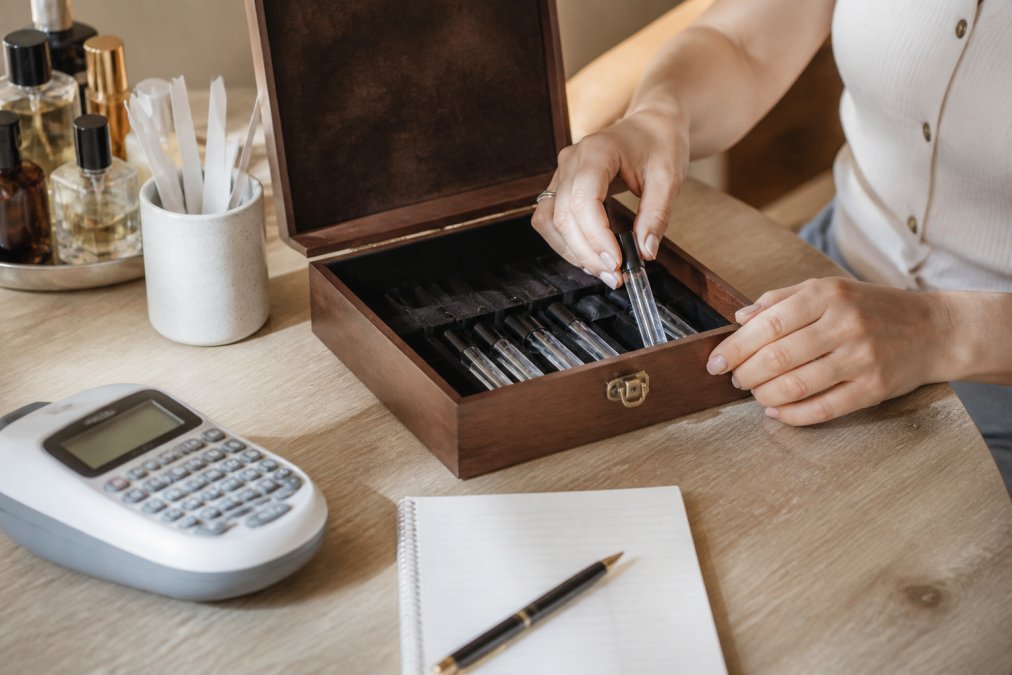
- Check every seal before storing. Turn each vial upside down and look for leaks.
- Keep decants upright. The upright position keeps liquid away from the cap and slows evaporation.
- Label each vial with the scent name and a batch code or date.
- Move the collection to a cool dark place, like a closed drawer or cabinet.
- Group by how often you wear them, so daily scents stay within reach.
- Log each decant in a notebook or app to track age and use.
Organizing Decants for Easy Access
An organizer keeps you from digging through a jumbled pile, which means fewer open-and-close cycles and less air exposure. An acrylic display works if it sits away from light. A closed wooden box is better.
Travel-Specific Storage Protocols for Perfume Decants
Travel is where most decants get ruined, and it is the topic nearly every storage guide skips. Two forces do the damage: pressure changes and temperature swings. Both are predictable, and both are manageable once you understand what is happening inside the vial.
What Pressure Changes Do to a Sealed Vial
A commercial cabin is pressurized to roughly the equivalent of 6,000 to 8,000 feet of altitude, and a checked bag in the hold can see even lower effective pressure. A vial sealed at sea level now holds air that wants to expand. That pressure has to go somewhere, and it pushes against the weakest point in the container, usually the cap gasket or the crimp on a sprayer.
Temperature Extremes in Transit
A checked bag in a hot climate can sit on a tarmac for an hour or more before loading, and cargo holds on the ground are not climate-controlled. The same bag can then sit in a cold hold at altitude. That is a rapid swing from hot to cold and back, which is exactly the pattern that stresses seals and accelerates the top-note loss described earlier.
A Packing Protocol That Survives Real Trips
- Decant into small glass vials with PTFE-lined caps, filled to about 80 percent.
- Wrap each vial individually in a foam sleeve or a square of bubble wrap, then tape the wrap closed so it cannot shift.
- Stand the wrapped vials upright inside a rigid hard case with a foam insert. A zip pouch offers no protection against pressure or impact.
- Place the hard case inside a sealed plastic bag as a secondary barrier against leaks.
- Keep the whole kit in your carry-on, never in checked luggage.
- On arrival, let the vials sit at room temperature for an hour before spraying. Cold liquid sprays unevenly and the first few sprays will smell off.
What Not to Do
- Do not fill vials to the top before a flight. Headspace is protection, not waste.
- Do not pack decants in a hot car or a checked bag, even for a short trip.
- Do not reuse a plastic travel vial across multiple trips. The seal and the wall both degrade, and the second trip is when it leaks.
- Do not trust a screw cap you have not leak-tested. Test it upside down for a minute before it goes in the bag.
Transportation Security Administration rules on traveling with liquids limits carry-on liquids to 3.4 ounces per container, which is why decanting into small vials before you fly is the practical approach for anything larger than a sample.
Signs of Scent Degradation and How to Track Your Decants
A scent has turned when it smells sharp, sour, or flat compared to when you bought it. Color shifts and a darker liquid are other warning signs.
- Top notes vanish or turn sour
- The liquid darkens or clouds
- The spray smells of alcohol or vinegar
- The scent fades within minutes of wearing
Frequently Asked Questions
How long do fragrance decants typically last if stored correctly?
Most fragrance decants last 1 to 3 years when kept in a cool, dark place with a tight seal. Decants in glass vials stored at consistent temperatures often outlast those in plastic, which can allow more evaporation and chemical interaction. Citrus-forward scents with volatile top notes may fade faster than resinous or oud-based perfumes. Always check the batch code and note the decant date.
Should perfume decants be stored upright or on their sides?
Store perfume decants upright. Keeping them upright prevents liquid from constantly contacting the cap or seal, which can degrade gaskets and allow evaporation. It also reduces the risk of leaks if the seal loosens. For travel, wrap each upright decant in a padded pouch or use a dedicated travel case that holds vials vertically inside your bag.
Are glass vials better than plastic for long-term decant storage?
Glass vials are better for long-term storage. Glass is non-reactive and does not absorb or alter fragrance oils, while some plastics can react with certain compounds in perfume, shifting the scent over time. Glass also provides a more reliable hermetic seal when paired with a quality atomizer or cap. Plastic works for short-term use, but glass protects scent integrity far better.
Can you store perfume decants in the refrigerator?
A refrigerator can work if the temperature stays steady and the decants are sealed airtight in a container away from food odors. The risk is temperature fluctuations each time the door opens, plus condensation when vials return to room temperature. For most people, a dark cabinet or closet with stable temperatures between 60 and 70 degrees Fahrenheit is a safer, simpler option.
Storing decants well is the difference between a collection that lasts and one that fades in a season. It comes down to three things: steady temperature, a dark spot, and a sealed glass vial. At Olfactory Outlaws, every decant arrives in a proper glass container, and our concierge team can help you build a rotation that fits how you actually wear scent. Explore our curated decants and let us match you with your next signature.